
Table of Contents
ToggleVastu for Home : Complete Guide to House Direction, Entrance, and Vastu Shastra Principles
What is Vastu Shastra ?
Vastu Shastra is the ancient Indian science of architecture and spatial design. It is not merely a collection of arbitrary rules or superstitious beliefs. Instead, it is a highly systematic approach aimed at harmonizing human dwellings with the natural elements, cosmic energies, and the magnetic fields of the Earth. By aligning building structures with these unseen yet powerful natural forces, Vastu seeks to ensure health, psychological peace, financial abundance, and overall domestic harmony for the residents.
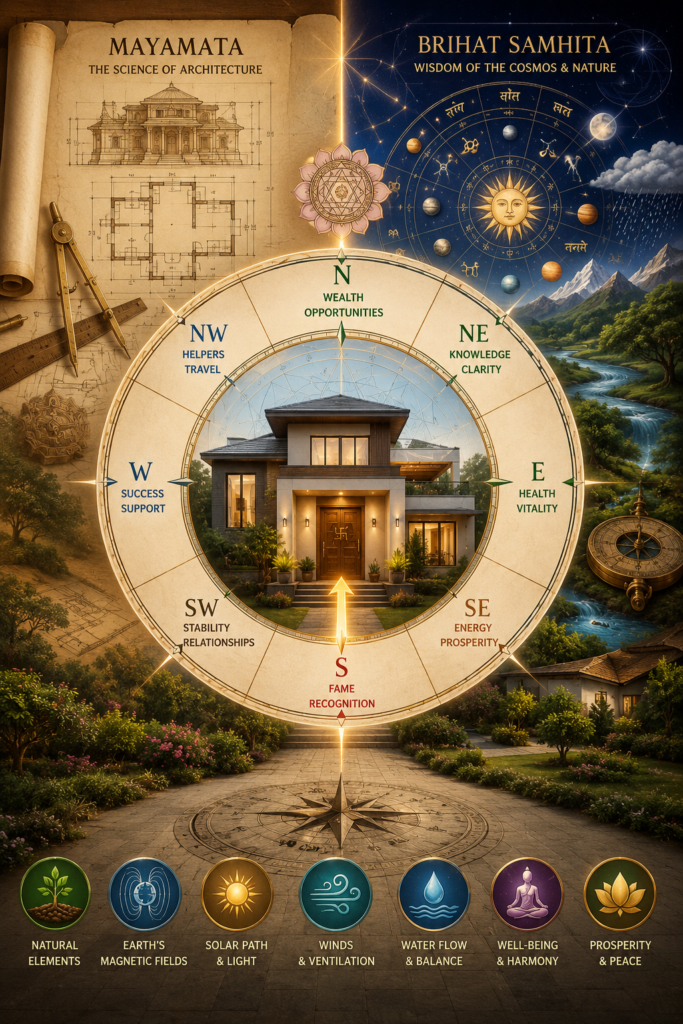
By blending the mechanical precision of the Mayamata with the astrological and natural wisdom of the Brihat Samhita, this guide presents a clear, readable, and highly authoritative look into the optimal placement and direction of your home’s main entrance.
Key Takeaways
- The main door (Mahadvara/Prathama Dvara) is the most important part of a house in Vastu Shastra, as it serves as the primary gateway through which Prana, light, and ambient vibrations enter the home.
- The principles explained are based on the classical texts Mayamata and Brihat Samhita, which emphasize direction, balance, proper use of space, and mathematically determined entrance placement.
- The exact location of the main entrance is determined using the Pada Grid System, where each side of the house is divided into nine equal Padas, each associated with a specific deity and traditional results.
- A house facing a particular direction is influenced by the qualities of its ruling Dikpala (deity) and planetary ruler, making the choice of entrance direction significant in Vastu planning.
- No house direction is universally good or bad. According to the classical texts, the precise Pada on the wall is more important than the overall facing direction of the house.
- The strongest message of Mayamata and Brihat Samhita is that the main door should be placed in the correct Pada with proper openness, suitable surroundings, and a clean approach, making Vastu a guide for balanced and planned living.
Why the Main Door is Important ?
Within the framework of Vastu Shastra, the main entrance door—historically known as the Mahadvara or Prathama Dvara—holds the absolute highest importance.The main door of a house acts as the primary gateway through which cosmic energy (Prana), vital life forces, light,and ambient vibrations enter the living space.
The true science behind this placement,comes from the foundation texts of Indian architecture.Brihat Samhita gives very clear rules about entrance placement, and Mayamata also supports the idea that the house should be planned with direction, balance, and proper use of space.
Basic Vastu for Home Entrance
In Vastu thought, the main door is not only an opening. It is the place where the house meets the outside world. That is why the classical texts connect the door with health, wealth, comfort, conduct, family harmony, and social life. If the entrance is made in certain parts, different results may follow, such as wealth, honour, anger, quarrels, loss, or disturbance.
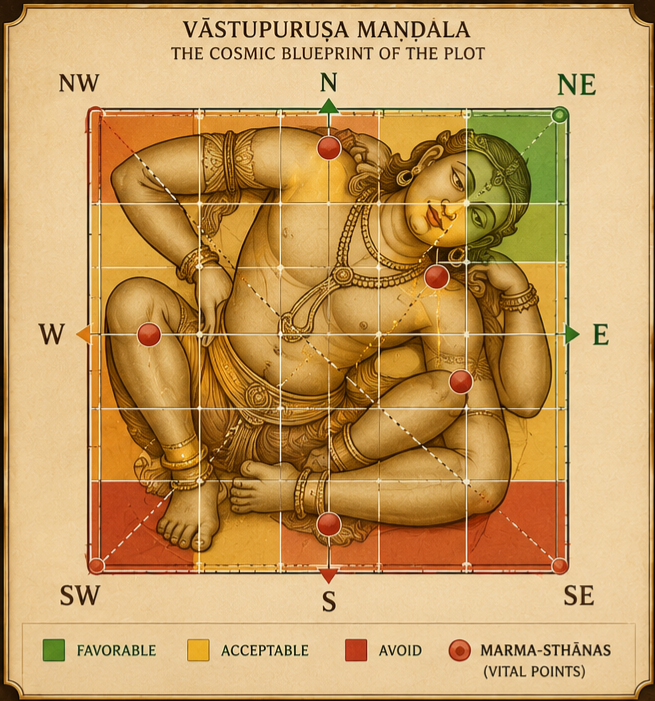
Our aim is to show the logic and traditional view behind home planning.The principle of Vāstupuruṣa lies with his head in the north-east, and the body is mapped onto the whole plot. The north-east corner is therefore delicate and should not be carelessly disturbed.It also warns that the main entrance should not block or injure vital parts, called marma-sthānas. The doorway placement is part of a full building science, not a random choice.
House Facing Direction and Planetary Lords in Vastu Shastra
Vastu Shastra divides the horizontal universe into eight primary directions: four cardinal directions (North, South, East, West) and four corner directions or intermediate points (North-East, South-East, South-West, North-West). Each of these directions is ruled by a specific deity (known as the Dikpala) and is deeply connected to a particular cosmic planet, as heavily emphasized in Varahamihira’s Brihat Samhita.
When energy flows from a direction, it carries the structural characteristics and qualities of its ruling deity and planet. Therefore, when you open your main door facing a particular direction, you are inviting that specific planetary energy to dominate your household. The table below outlines these relationships as defined in classical texts:
| Direction | Sanskrit Name | Ruling Deity (Dikpala) | Planetary Ruler | Primary Quality & Influence on Home |
| East | Purva | Indra (King of Gods) | Sun (Surya) | Enlightenment, health, vitality, social status, and beginnings. |
| South-East | Agneya | Agni (God of Fire) | Venus (Shukra) | Energy, physical passion, cooking, financial transactions, and sparks. |
| South | Dakshina | Yama (God of Justice/Death) | Mars (Mangal) | Discipline, structural strength, storage, but risk of legal issues if broken. |
| South-West | Nairutya | Niruthi (Demon/ Ancestor Lord) | Rahu (North Node) | Heaviness, stability, accumulation, dark spaces. Highly dangerous for doors. |
| West | Paschima | Varuna (God of Water/Oceans) | Saturn (Shani) | Hard work, stability, evening reflection, structured growth. |
| North-West | Vayavya | Vayu (God of Wind) | Moon (Chandra) | Movement, travel, change, relationships, guest entry, and liquidity. |
| North | Uttara | Kubera (God of Wealth) | Mercury (Budha) | Financial flow, business growth, clear communication, and education. |
| North-East | Eeshanya | Eeshana (Form of Shiva) | Jupiter (Guru) | Pure spirituality, extreme wisdom, mental clarity, and divine blessing. |
Main Door Placement (Pada System)
The important vastu tip for finding the precise door location is through the Pada Grid System.A major misconception in modern times is that certain directions like the South are universally evil, while directions like the East are universally perfect. The ancient scriptures prove this wrong by introducing a beautiful mathematical system known as the Pada Grid System, which splits each side of a house into micro-zones.
The Pada Grid System: How to Find the Exact Main Door Location in Vastu Shastra
According to the Mayamata and Brihat Samhita, the main door position is determined using the Vastu Purusha Mandala, a sacred architectural grid used in Vastu Shastra.
What is the Vastu Purusha Mandala?
- The Vastu Purusha Mandalais a sacred grid used for planning a house according to Vastu Shastra.
- It represents the Vastu Purusha, a cosmic being whose body is believed to be occupied by different deities.
- Different parts of the grid are associated with different divine energies.
- The Mayamataand Brihat Samhita use this grid to help determine the ideal location for the main entrance.
Which Grid is Used for Main Door Placement?
Traditional Vastu uses two commonly known grid layouts:
Grid Name | Layout |
Paramasayika Grid | 81 squares (9 × 9) |
Manduka Grid | 64 squares (8 × 8) |
These grids are used to analyse the walls and boundaries of a house for proper main door placement.
How is the Main Door Position Decided?
Follow these simple steps to locate the correct main door position according to the Pada system:
- Divide the outer wall of the side where the main entrancewill be placed into 9 equal parts.
- Each part is called a Pada(step or zone).
- Repeat this process for any of the four main sides of the house, if required.
- Together, the outer boundary of the house contains 32 Padas.
- Every Pada is associated with a specific divine energy.
- The Brihat Samhitadescribes these 32 peripheral deities and explains the traditional results of placing the main door in each Pada.
How to Calculate One Pada?
You can apply this traditional method using a simple calculation:
- Measure the total length of the front wall from one corner to the other.
- Divide the total wall length by 9.
- The result is the length of one Pada.
Formula:
One Pada = Total Length of the Front Wall ÷ 9
How to Count the Padas
While standing outside your house and facing the wall where the main door will be placed:
- Start counting from the left-hand corner.
- Continue counting towards the right-hand corner.
- Mark all 9 equal Padasbefore identifying the appropriate location for the main entrance.
Vastu for East facing House
When standing outside looking at an East-facing house, count the 9 Padas from the North-East corner (left) to the South-East corner (right):
- Pada 1 (Shikhi / Ishana): Located at the absolute North-East corner. A door here causes fire hazards, unnecessary expenditures, or spiritual extreme detachment. Unsuitable for regular family life.
- Pada 2 (Parjanya): The energy of rain and clouds. Building a door here leads to an increase in female births in the family, high emotions, and general peace. It is considered neutral to mildly good.
- Pada 3 (Jayanta): The energy of victory and success. Highly Auspicious. A door here brings massive financial success, intellect, victory over enemies, and official growth.
- Pada 4 (Indra): The king of gods. Highly Auspicious. Placing the door here ensures Royal favor, high social status, immense wealth, and deep respect in society.
- Pada 5 (Surya): The Sun god. A door here causes excessive anger, pride, health issues related to heat, and constant government or legal scrutiny. It is generally avoided for normal households.
- Pada 6 (Satya): The energy of truth. It promotes honesty but can cause severe losses through speaking direct truths, theft, or sudden arguments with family. Neutral.
- Pada 7 (Bhrisha): Excessive desires. A door here leads to cruelty, loss of empathy, and wasteful expenses based on greed. Unfavorable.
- Pada 8 (Antariksha): The open sky or void. A door here results in sudden thefts, financial cheating, and empty promises from others. Bad.
- Pada 9 (Agni): The South-East corner. A door here causes constant domestic fights, accidents involving fire, and long-term health issues for children. Completely forbidden.
Pada | Deity / Zone | Recommendation |
Pada 1 | Shikhi / Ishana (North-East Corner) | ❌ Unsuitable |
Pada 2 | Parjanya | ⚠️ Neutral to mildly good |
Pada 3 | Jayanta | ✅ Highly Auspicious |
Pada 4 | Indra | ✅ Highly Auspicious |
Pada 5 | Surya | ❌ Generally Avoided |
Pada 6 | Satya | ⚠️ Neutral |
Pada 7 | Bhrisha | ❌ Unfavorable |
Pada 8 | Antariksha | ❌ Bad |
Pada 9 | Agni (South-East Corner) | ❌ Completely Forbidden |
Vastu for West facing House
The Nine Padas of the Western Wall
When standing outside looking at a West-facing house, count from the South-West corner (left) to the North-West corner (right):
- Pada 1 (Pitri-edge): Deeply unstable, continues the negative curses of the South-West zone.
- Pada 2 (Dauvarika): The gatekeeper. Creates unnecessary hard work where the resident works day and night but others take the credit. Neutral.
- Pada 3 (Sugriva): Well-necked or stable. Highly Auspicious. Brings incredible academic growth, steady financial profits in business, and overall stability for the family.
- Pada 4 (Pushpadanta): The flower-toothed cosmic elephant. Highly Auspicious. This is the crown jewel of West doors. It ensures magnificent luxury, birth of healthy children, and steady accumulation of property.
- Pada 5 (Varuna): The God of Oceans. A door here brings neutral results mixed with emotional over-thinking. Good for creative people, risky for dry businesses.
- Pada 6 (Asura): The negative force. Brings mental depression, massive debt, addiction, and a constant feeling of tiredness. Bad.
- Pada 7 (Shosha): Drying up. It literally dries up the wealth and health of the residents. Constantly high medical bills. Bad.
- Pada 8 (Roga): Disease. Causes psychological issues, depression, and localized bodily pain. Unfit for an entry.
- Pada 9 (Vayu / North-West edge): Leads to a highly unstable life where residents are forced to move away from home constantly, suffering losses.
| Pada | Deity / Zone | Recommendation |
|---|---|---|
| Pada 1 | Pitri-edge (South-West Corner) | ❌ Unfavorable |
| Pada 2 | Dauvarika | ⚠️ Neutral |
| Pada 3 | Sugriva | ✅ Highly Auspicious |
| Pada 4 | Pushpadanta | ✅ Highly Auspicious |
| Pada 5 | Varuna | ⚠️ Neutral |
| Pada 6 | Asura | ❌ Bad |
| Pada 7 | Shosha | ❌ Bad |
| Pada 8 | Roga | ❌ Unfit for Entry |
| Pada 9 | Vayu (North-West Edge) | ❌ Unfavorable |
Vastu for North facing House
The Nine Padas of the Northern Wall
When standing outside looking at a North-facing house, count from the North-West corner (left) to the North-East corner (right):
- Pada 1 (Roga-edge): Unstable entry point, leads to regular family disputes.
- Pada 2 (Naga): The cosmic serpent. Brings jealousy from neighbors, fear of legal action, and hidden enemies. Avoid.
- Pada 3 (Mukhya): The chief engineer or prime face. Highly Auspicious. Leads to immense wealth, outstanding professional success, and continuous happiness for the family head.
- Pada 4 (Bhallat): Abundance. Highly Auspicious. This zone attracts massive financial gains, unexpected inheritances, and deep spiritual contentment.
- Pada 5 (Soma / Kubera): The Moon/Wealth Lord. Highly Auspicious. Brings peaceful mind, heavy cash flows, domestic bliss, and great relations with outsiders.
- Pada 6 (Bhujanga): The guardian snake. It can cause sudden issues with siblings or legal trouble related to ancestral property. Neutral.
- Pada 7 (Aditi): The mother of gods. Promotes focus, stability, and good qualities in children, but a door here can sometimes restrict independent income. Neutral.
- Pada 8 (Diti): Split vision. Brings a narrow mindset, excessive worry, and a tendency to make wrong financial choices. Unfavorable.
- Pada 9 (Shikhi / North-East edge): Destroys cash savings completely, causes emotional instability, and fire threats.
Pada | Deity / Zone | Recommendation |
Pada 1 | Roga-edge (North-West Corner) | ❌ Unfavorable |
Pada 2 | Naga | ❌ Avoid |
Pada 3 | Mukhya | ✅ Highly Auspicious |
Pada 4 | Bhallat | ✅ Highly Auspicious |
Pada 5 | Soma / Kubera | ✅ Highly Auspicious |
Pada 6 | Bhujanga | ⚠️ Neutral |
Pada 7 | Aditi | ⚠️ Neutral |
Pada 8 | Diti | ❌ Unfavorable |
Pada 9 | Shikhi (North-East Edge) | ❌ Unfavorable |
Vastu for South facing House
The Nine Padas of the Southern Wall
When standing outside looking at a South-facing house, count from the South-East corner (left) to the South-West corner (right):
- Pada 1 (Anila / Agni-edge): Brings issues related to fire, arguments between couples, and loss of money.
- Pada 2 (Pusha): Servitude. It forces the residents to work like servants for others, losing self-respect.
- Pada 3 (Vitatha): Falsehood and pretense. A door here creates a family dynamic based on lies, bad reputation, and internal bitterness.
- Pada 4 (Grihakshata): Damage to the household. Highly Auspicious. According to Varahamihira, despite being on the South, this specific zone brings fame, abundance, and protection.
- Pada 5 (Yama): The Lord of Justice. Auspicious for certain professions. It brings immense wealth and administrative power but demands absolute discipline. For common families, it can sometimes feel overly harsh or stressful.
- Pada 6 (Gandharva): Celestial musicians. Brings fame in arts, regular celebrations, and luxury, but can lead to a lack of savings. Neutral to good.
- Pada 7 (Bhriga-raja): The dark side of cosmic rules. Results in loss of physical strength, continuous diseases among male members, and poverty. Bad.
- Pada 8 (Mriga): The wild animal element. Deprives the family of mental peace, creates a lonely environment, and causes children to turn rebellious.
- Pada 9 (Pitri / Nairutya-edge): The absolute South-West corner. A door here brings intense bad luck, sudden deaths, chronic illness, and total financial destruction. Completely forbidden.
| Pada | Deity / Zone | Recommendation |
|---|---|---|
| Pada 1 | Anila / Agni-edge (South-East Corner) | ❌ Unfavorable |
| Pada 2 | Pusha | ❌ Unfavorable |
| Pada 3 | Vitatha | ❌ Unfavorable |
| Pada 4 | Grihakshata | ✅ Highly Auspicious |
| Pada 5 | Yama | ⚠️ Auspicious for Certain Professions |
| Pada 6 | Gandharva | ⚠️ Neutral to Good |
| Pada 7 | Bhriga-raja | ❌ Bad |
| Pada 8 | Mriga | ❌ Unfavorable |
| Pada 9 | Pitri / Nairutya-edge (South-West Corner) | ❌ Completely Forbidden |
Conclusion
The Mayamata and Brihat Samhita prove that the direction your main door faces is a sophisticated mathematical calculation, not an unchangeable dogma. By dividing your outer walls into 9 precise Padas and keeping the entrance in the positive zones—such as Jayanta or Indra in the East, Mukhya or Bhallat in the North, Pushpadanta in the West, or Grihakshata in the South—you can design a home that naturally protects its residents from natural stress and actively invites cosmic blessings.
Wall Orientation | The Absolute Best Padas (Gold Zones) | The Best Alternate Padas (Silver Zones) | Strictly Forbidden Padas (Danger Zones) |
East Face | Pada 3 (Jayanta) & Pada 4 (Indra) |
Pada 2 (Parjanya) | Pada 1 (Shikhi) & Padas 5 to 9 |
South Face |
Pada 4 (Grihakshata) | Pada 5 (Yama) & Pada 6 (Gandharva) | Padas 1, 2, 3, 7, 8 & 9 (Pitri) |
West Face |
Pada 4 (Pushpadanta) | Pada 3 (Sugriva) & Pada 5 (Varuna) |
Padas 1, 2, 6, 7, 8 & 9 |
North Face | Pada 3 (Mukhya), Pada 4 (Bhallat) & Pada 5 (Soma) |
Pada 7 (Aditi) |
Padas 1, 2, 6, 8 & 9 |
The strongest message from Brihat Samhita and Mayamata is balance. The main door should not be chosen only by a single rule; it should be placed in the right zone, with proper openness, right surroundings, and a clean approach. For most readers, the safest simple understanding is this: north and east are usually preferred, but the exact placement on the wall matters more than broad labels. South, west, and corner entrances are not always wrong, but they need more care and a better overall layout. If this science is read in a calm and practical way, it becomes a guide for planned living rather than a source of fear. That is the spirit in which the classical texts should be understood.
Frequently Asked Questions
Is a South-Facing House Really Bad According to Vastu Shastra?
A south-facing house is not inherently inauspicious. According to the Pada Grid System described in the Mayamata and Brihat Samhita, the exact location of the main door is more important than the facing direction itself.
Does the Direction of the House Matter More Than the Exact Position of the Main Door?
The precise Pada (zone) of the main entrance is more important than whether the house faces north, south, east, or west.
How Do I Find the Correct Main Door Position According to Vastu Shastra?
By the process using the Vastu Purusha Mandala and the Pada Grid System, including dividing the wall into nine equal parts and counting the Padas correctly.
Is East-facing houses are always perfect?
Even an east-facing house has both highly auspicious and completely forbidden space for main door positioning.